Release Date 07.09.2026
In this little dev blog we want to update you on the upcoming adjustments for underground resources, starting with a little timeline.
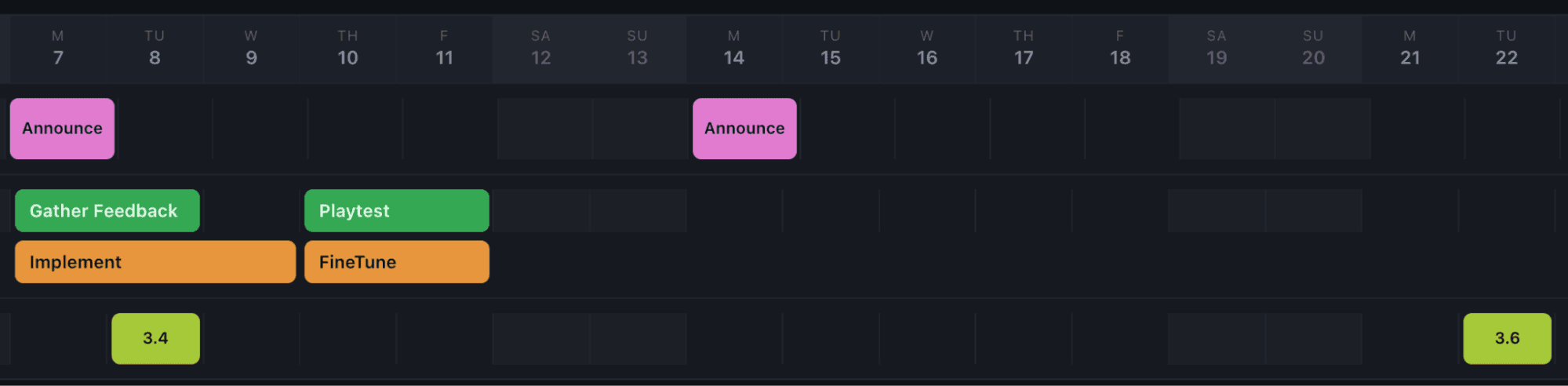
Release 0.3.4
As already announced, repair will no longer consume rare resources through the production chain of materials.
The usage of rare ores for furniture will mostly be removed, with some exceptions in which the required amount was reduced by around 80%.
These changes should go live tomorrow, September 8, 2026.
We hope that this adjustment balances out the availability and demand for rare ores by establishing them as opt-in resources for late-game strategies.
This week (September 7 to 11)
We are lining up a variety of adjustments for 3.6, which is planned to go live on September 22.
Today, we want to communicate our current ideas for 3.6 and gather feedback, to evaluate the potential impact of our changes.
After evaluating the feedback and potentially adjusting our plans and implementation, we would like to give a selection of players the chance to test the changes together with us around September 10.
Along with this test, we want to gather in-depth feedback, finetune our planned changes and see if we are on a good track for 3.6. If the test indicates that further improvements are necessary, we will keep iterating and postpone the release of a revised version to 3.7 or later.
Planned changes (0.3.6)
The plan for the following changes may be subject to change depending on feedback.
1. Building palette
Rare ores are mostly removed as requirements for all building palettes, either fully, or mostly. If rare ores remain a part of construction, it should be a small part that could narratively be related to the internal wiring or elevators.
2. Number of extractions per underground tile
Underground tiles at higher levels of abundance will receive an extra amount of possible extractions.
Hematite
Planned for 3.6
Abundance
This level
Total
10%
80
80
20%
80
160
30%
80
240
40%
140
380
50%
200
580
60%
300
880
70%
400
1280
80%
600
1880
90%
1000
2880
100%
1600
4480
Aurite
Planned for 3.6
Abundance
This level
Total
10%
3
3
20%
5
8
30%
10
18
40%
15
33
50%
20
53
60%
30
83
70%
50
133
80%
70
203
90%
120
323
100%
180
503
(Numbers above are work in progress)
The table above shows an example for how the yield at different levels of abundance could look like for Aurite and Hematite.
This type of curve will likely be applied to all ores and coal.
Existing tiles that have already been mined will receive the added bonus per tier, based on their original level of abundance. An Aurite tile at abundance 5 would receive the adjusted bonus for level 5,4,3,2,1 for example.
Rationale: The intention is to help with (1.) making underground tiles with high abundance feel worthwhile and (2.) providing tiles of common ores that can be harvested for longer periods of time. Scaling up the bonus throughout the different levels (instead of increasing all levels equally) helps with (1.) staying within the budget of resources we can currently provide on the map and (2.) creating more noticeable differences in the value of individual tiles and 100x100 square-meter territory tiles as a whole.
3. Random spawns
Two new objects will appear and respawn on the map:
Debris: Can be harvested for raw metals or basic metallic components
Ore Rubble: Can be harvested for ores
Rationale: This should provide a sustainable source of ores as a backup plan for societies that run out of ores. While we aim to provide enough underground resources for societies to progress to late stages of the game without the need for relying on the import of common resources, this functions as a safety net. At the same time, it is a step in the right direction of making exploration gameplay a competitive source of SeedCoin that competes and possibly surpasses the NPC buy orders as the primary source of SeedCoin in the overall economy.
This change will be introduced as a gradual transition, to avoid disruptions to the ore-mining industry.
4. Water
The underground tiles for water should refill over time. The rate at which they refill is limited, so that societies may need to plan how many drills are placed on a given tile.
5. Extractor bugs and UI
We are investigating the feedback around possible bugs for the extraction of resources.
Tiles depleting without generating yield
Inconsistencies with multiple extractors running in parallel
Our current evaluation indicates that the information shown for extractors and underground tiles may be either misleading or unclear. We are investigating ways to communicate the amount of possible extraction and remaining yield more clearly.
6. Scanner
We are processing feedback for the Scanner too and investigating potential improvements. Our current findings indicate that in some cases the results do not appear, as mentioned in some of the reports.
Current balance
In this section we would like to clarify the current state of the balance for underground resources.
Each underground tile has a value called abundance that is between 10% to 100%.
Abundance is decreased in steps of 10%.
The number of extractions needed for decreasing the abundance of a tile by 10% depends on the type of resource.
The following list shows the intended number of extraction needed for decreasing the abundance of an underground tile by 10%:
Water
2000
Hematite
80
Clay
80
Stone
80
Chalcopyrite
12
Bauxite
5
Rutile
5
Argentite
3
Aurite
3
Coal
2
Example:
A water tile with 60% abundance can be harvested 12000 times.
Each extraction yields 10 units of water
Result: water tile with 60% abundance produces 120000 units of water
Water
Currently
Abundance
This level
Total
10%
2000
2000
20%
2000
4000
30%
2000
6000
40%
2000
8000
50%
2000
10000
60%
2000
12000
70%
2000
14000
80%
2000
16000
90%
2000
18000
100%
2000
20000
The abundance of an underground tile impacts the chance of successfully producing an ore directly by the given percentage value.
Playtest balance
The updated values for the playtest will be presented along with the playtest.
Thanks for reading!