Release Date 14.08.2026
Resources in SEED
In this blogpost we want to provide additional context for our changes to rare resources in SEED. The post will cover both past and upcoming changes, along with notes on the direction for related gameplay loops.
Changes
Past Changes
We have recently reduced the yield of rare deposits on the surface:
200 -> 20
100 -> 15
50 -> 10
This change was applied to Bauxite, Rutile, Argentite and Aurite.
Along with changes to the surface, we have changed the logic for underground resources: All underground resources are now modelled as independent tiles below the surface rather than areas around surface deposits. Common resources like Hematite still have a dedicated area of underground resources around them, which is meant to exist during a transition period.
Players can now use a scanner to find underground resources, which is necessary for finding rare ores below the surface.
We also disabled the extraction of rare resources with the small version of the Resource Extractor as a temporary measure, more on that later.
Upcoming Changes
Starting with the August 25 release, underground resources will deplete as they are extracted.
This means that each underground resource tile can only be extracted a set number of times before it is depleted.
Along with this, we will remove the underground tiles that were automatically spawned around common surface deposits like water, which were added to give players time to craft scanners and find alternative tiles for their existing extractors.
The recipe of the Scanner and Power Cell will be simplified to allow players to be able to detect underground resources earlier in their progression.
Also, the smaller version of the Resource Extractor will be able to extract rare resources like Aurite from underground tiles again.
Rationale
Many of the changes above have been made to limit the amount of rare resources in circulation.
We will start with detailed notes on two specific changes before looking into the general direction.
Reducing the yield of rare deposits on the surface:
We noticed that the amount of harvested ores went beyond our expectations in the live game and decided to reduce the maximum yield in a hotfix. Ideally we should have made this change before the Early Access release, but since we missed that, the change to surface resources seemed like a necessary step for preventing a potential oversupply of rare resources.
Disabling the extraction of rare resources with the small version of the Resource Extractor: Due to the small placement bounds of the small extractor we saw the potential for players to extract a high amount of rare resources by placing many small extractors on a single tile of a rare resource, which we wanted to avoid before introducing the depletion of underground resources to, again, avoid a potential oversupply of rare resources.
With that being said, we recognize that the past changes came very abruptly and we apologize for the inconvenience this brought to players in the live game.
Future Direction
Collaboration and Competition
Rare resources play a critical role in the collaborative and competitive aspects of SEED.
From our perspective, a thriving economy in SEED is characterized by a circulation of resources that is driven by the engagement of players with each other. This applies to both items and Seedcoin.
In order to make it fun for players to engage in this way, there must be a good reason in doing so.
One existing driver for economic engagement is the Skills system: ‘your Seedling is good at this, my Seedling is good at something else, and therefore we trade or run a business together, to maximize our gains’.
Rare resources come in as another economic driver by creating differences in how many resources are available to societies based on their location.
In simple terms: my society has a lot of gold but lacks silver, for your society it’s the other way around, and therefore we both benefit from buying what we lack and selling what we don’t need. On top of the local differences, rare resources are meant to be scarce. This means that players should have more things they want to build with rare resources than they have rare resources to build them with.
Rare resources should never feel like a blocker for basic progression beats or the survival of Seedlings - the scarcity is meant to apply to later stages of the game, at which players are shaping the high-end lifestyle of their Seedlings.
Advanced items like more efficient versions of entry-level machines intentionally rely on electronic components that require rare ores in their supply chain. By driving scarcity this way, we want to foster a more dynamic supply and demand that brings in a subjective evaluation of prices - ‘I know the high price for this Gold Wire is not justified by the time & expertise for making it, but I don’t have gold myself & really want it to finish my project’.
Exploration
Apart from driving and diversifying supply and demand on the market, the scarcity of resources is also meant to support the exploration gameplay.
The general vision for exploration in SEED is to provide players with a form of active gameplay that is accessible to all levels of experience. We want to offer a vast living world to players that feels full of surprises and opportunities waiting to be discovered.
In order to fuel this sense of wonder, it is critical for us to control the rate at which players will discover certain parts of the world, so that worthwhile discoveries can be made even after multiple trips to nature.
For rare ores specifically this means: a relative scarcity gives us developers a way to create meaningful discoveries. In other words, if societies were full of gold, the discovery of gold below the surface would likely feel less meaningful.
In order to further increase the variety of discoveries through scanning, underground tiles have different levels of abundance. A player that discovers a tile of Aurite at low abundance, for example, can still look forward to finding one with high abundance.
Our direction for the exploration loop in 2026 is roughly:
Players go out to gather valuable materials on the surface, both organic and inorganic
Players use the scanner on the side to find rare underground resources on the go
Players use the data of scanners to inform the decisions for claiming far-away territory with their society
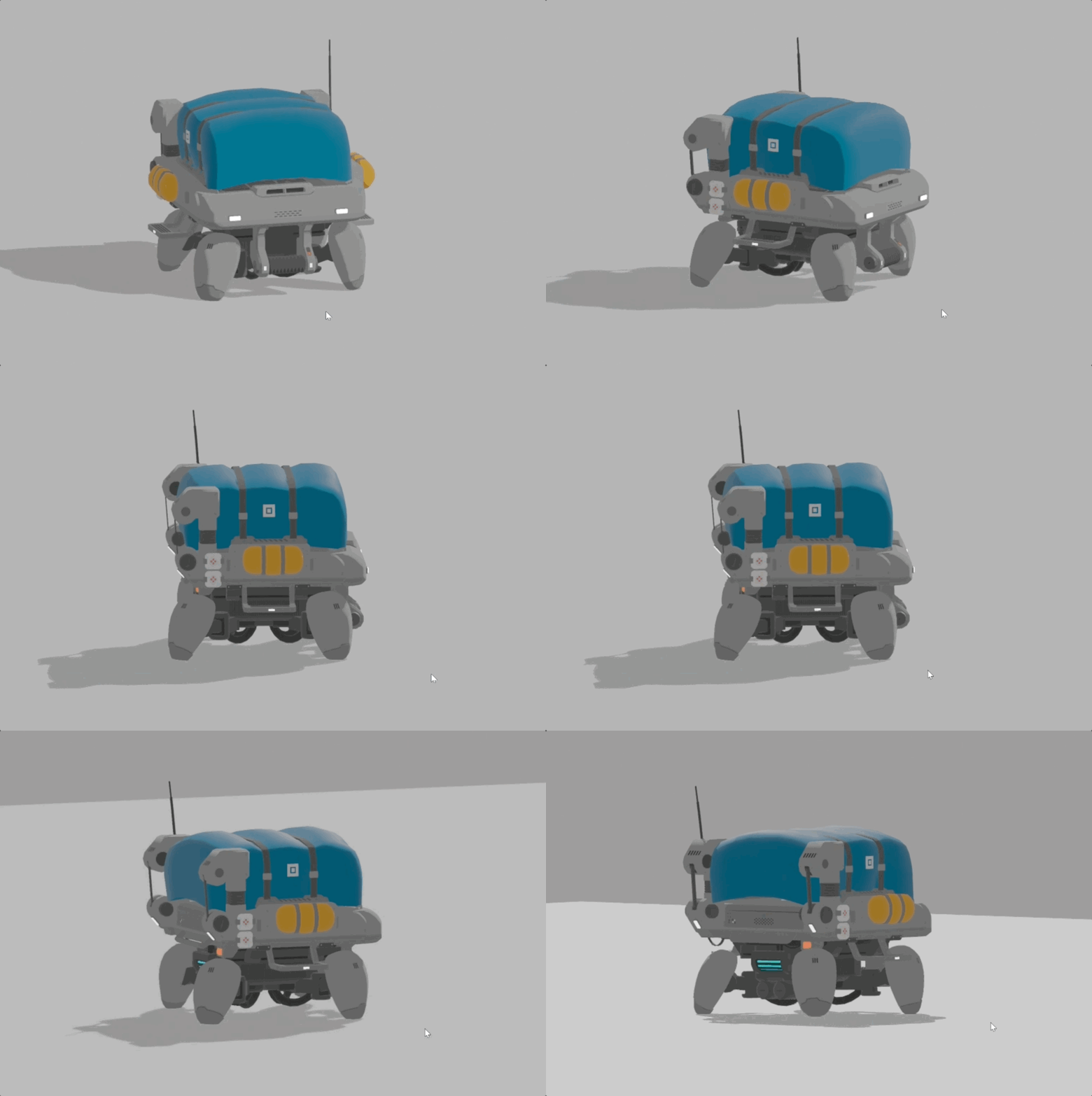
Image: Introducing the MTU, or Mobile Transport Unit. Coming soon, this sturdy, little guy can help explore and gather resources in places beyond your wildest dreams. Courtesy: Frontiers Engineering.
Depletion of Common Resources
Common underground resources like Hematite will deplete, too, but should last much longer compared to rare ores.
Societies should be able to sustain themselves with common resources for a very long time, and it is not our intention to apply a lot of pressure to territorial expansion from this angle.
The finiteness of common underground resources should provide new societies with an entry point for global trade and make for a more inclusive economy where players at all skill levels can contribute. At the same time we see opportunities for introducing new systems to go along with finite underground resources in the future, such as machines or drones that collect resources from the general environment.
Conclusion
We hope that the context provided in this blog-post helps to outline how the scarcity of resources are meant to help with creating an interesting and dynamic game-world.
We really want to emphasize that resources should have been scarce and finite to begin with - retroactively taking things out of the world really is something that we see as an absolute last resort.