Release Date 23.02.2026
Blog # 2: ‘From Eilo Toadstools to Verdantis Fingers’
The Mycelial Network, Siro Spores and Flora
If Verdantis is the stage upon which Seedling history has repeatedly been set and reset, then the mycelial network beneath its soils is the script that was already there long before the first footfall. To understand life on Avesta – both its abundance and its fragility – we must look downward, into the living lattice that binds together soil, stone, water, and air. Nowhere is this more apparent than in the Verdantis continent and the adjacent Eilo Archipelago, where the planet’s most studied biological systems are most densely interwoven.
The Subterranean Web
The Avestan mycelial network is not merely analogous to Earth fungi: it is foundational. Threadlike hyphae permeate nearly every stratum of Verdantis soil, from the temperate loams of the western lowlands to the colder, mineral-rich substrates nearer the Session Range. On the Eilo Archipelago, where topsoil and stony soils dominate, the network is denser still, forming braided mycorrhizal shrooms that Seedlings love to harvest and munch on.
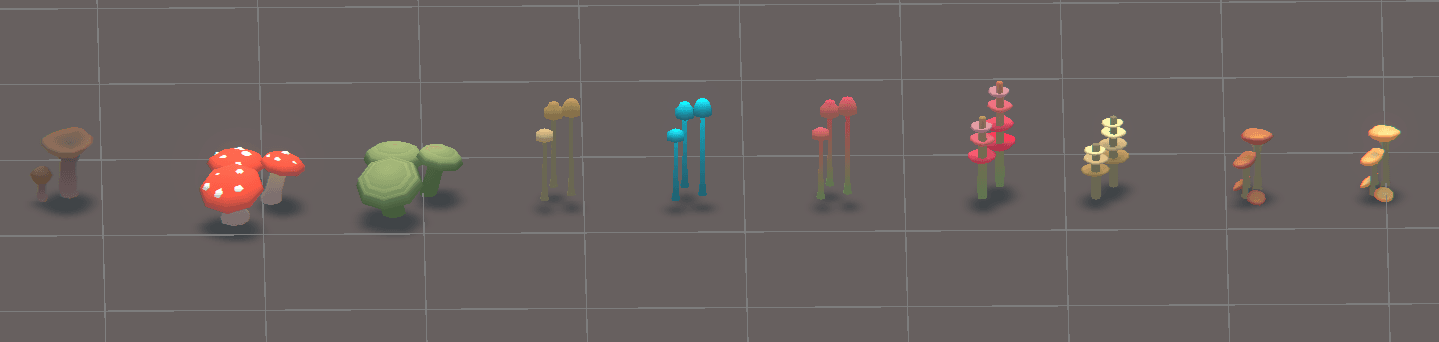
Caption: The full range of Mycorrhizal plants, from the Eilo toadstool to the Verdantis redringed finger. Courtesy: The Museum of Natural History, Metahaven.
Siro Spores: The Lethal Bloom
At the heart of this system lie the siro spores, the most infamous and consequential biological agents on Avesta. These microscopic reproductive bodies are released by several dominant fungal clades native to Verdantis and Eilo alike. In their dormant state, siro spores move in storm clouds, carried through air, often taking on red hue when coming into contact with water, leading to red clouds and magenta rain. It is only upon exposure to the specific biochemical signatures of living biological entities photosylium is released, expands, and in Seedlings leads to asphyxiation. For Seedlings, siro exposure is almost universally fatal.
It is this lethality that necessitated in the first place the Era of MX Terraforming. Large-scale spore suppression, soil vitrification, and atmospheric filtration were required before sustained surface life could even be attempted. But these efforts only went so far, and even when areas were able to be accessed by Pioneers, the periodic resurgence of spores was one of the principal forces behind the cyclical rise and collapse of Seedling cultures.
The Siro Life Cycle
Spore Phase Siro and related spores are produced in vast quantities by mature fruiting bodies. Carried by wind currents across the Sea of Verdantis from Athora or lofted by thermal updrafts from the southern hemisphere, they ensure planetary saturation.
Germination In suitable substrates – mineral soil, decaying biomass, or living hosts – the spores germinate, sending out primary hyphae. In non-Seedling environments, this process is slow and largely symbiotic.
Mycelial Expansion Hyphae interlink with the existing network, exchanging genetic and chemical information. At this stage, the fungus becomes part of the planetary system rather than an individual organism.
Photosylium & Fruiting Under specific environmental triggers – seasonal shifts, nutrient surpluses, or mass die-offs – the network produces photosylium. These range from small, shelf-like growths to towering, coral-structured mushrooms unique to Verdantis. There are many mushrooms and other fungal plants that Seedlings can enjoy and eat: the mycelial network is pluralistic and non-hierarchical.
Release and Renewal Spores are dispersed, the cycle recommences, and the network subtly recalibrates itself based on the success or failure of the previous generation.
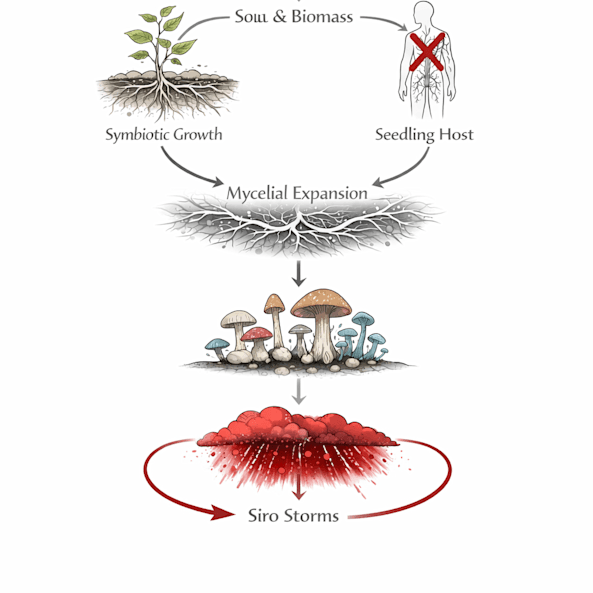
Caption: The full cycle of siro, including the dormancy that makes it so hard to eradicate siro completely. Courtesy: The Museum of Natural History, Metahaven.
A Living Constraint
After the interventions of Seed Industries and the guiding hands of Cultivators, no other force has shaped Seedling life so completely, or so ruthlessly, as these storms of spores that periodically sweep across Verdantis and the Eilo Archipelago. A siro season can undo decades of growth in a matter of weeks. In this way, the storms define not only mortality, but possibility: where one may settle, how large a population may grow, how permanent a structure is allowed to become before the planet reminds its inhabitants of the terms.
The end of a town, a culture, even an era is imagined not as fire or flood, but as a reddening sky and the soft, relentless fall of spores. Fittingly, the true engine of this power remains mostly out of sight. The vast mycelial network that generates siro storms lies beneath soil and stone, unseen and largely unmapped. What Seedlings encounter at the surface – the glowing shelves, the towering shrooms, the “happy and tasty” mushrooms of the islands – are only the tip of the iceberg.
Culture, like agriculture, must always be provisional, built with the knowledge that it stands on borrowed ground. This is evident in verse and art, summed up in the lines of Metahaven’s Henry Henry, their poet laureate:
When the siro comes, it comes like memory:
soft, total, impossible to fence.
And when it goes, the ground remembers us
longer than we remember ourselves.